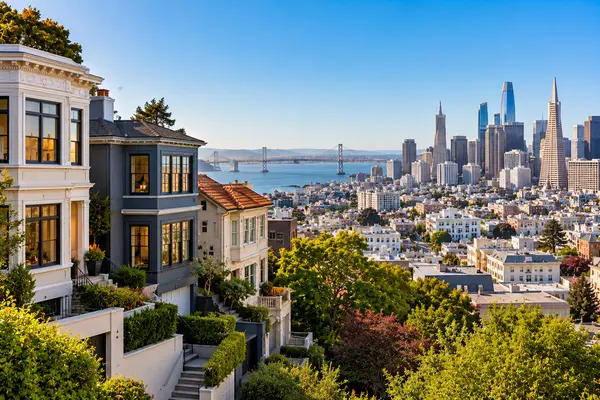
Is Potrero Hill a Good Long-Term Real Estate Investment?
Potrero Hill, a neighborhood on San Francisco's east side, can be a sound long-term real estate investment for buyers prioritizing appreciation, residential quality, and resale depth over maximum immediate rental yield. The neighborhood combines a premium acquisition basis with proximity to major employment districts, constrained hilltop housing supply, and a buyer pool that values views, outdoor space, parking, and well-maintained architecture. Investors should underwrite each asset individually, with close attention to tenancy, building condition, regulatory status, and the likely future owner-occupant audience.
Potrero Hill Real Estate Investment Metrics
The following figures reflect aggregated residential sale data for the three months ending August 2026.
- Median home sale price: $1,637,500, three months ending August 2026
- Year-over-year price change: 46.9%, three months ending August 2026
- Average days on market: 19 days, August 2026
Potrero Hill records a relatively small number of sales in any given quarter, so the mix of homes that close (a few view houses versus mostly condominiums, for example) can move the median sharply. Treat the year-over-year figure as a signal of strong recent demand rather than a measure of what any single property gained.
The Long-Term Potrero Hill Real Estate Investment Case
Potrero Hill is primarily an appreciation-led investment market, with rental income playing a supporting role in most purchase decisions. The three-month median sale price reached $1,637,500 through August 2026, with a 46.9% year-over-year increase in aggregated residential sale data. That movement indicates strong recent demand, although it should not be treated as a guaranteed forward return.
The long-term case rests on the neighborhood's constrained physical setting and its mix of detached homes, condominiums, and small multifamily buildings. Much of the hill is established residential fabric, so investors are generally buying into an existing neighborhood rather than relying on large-scale new supply within the core residential streets.
Development within the neighborhood can still affect demand. The Potrero HOPE SF redevelopment plan includes housing, public facilities, open space, streetscape work, and neighborhood-serving uses, creating a long-term change around the public-housing site on the hill's south slope. That future supply should be evaluated alongside the potential for improved connectivity and amenities.
For most investors, Potrero Hill fits a patient buy-and-hold strategy. A property with usable outdoor space, parking, strong light, functional bedrooms, and a clear resale story can appeal to renters today and future owner-occupants later. Investors seeking aggressive near-term cash flow may find the premium acquisition basis less accommodating.
Economic Fundamentals Supporting Potrero Hill Demand
Potrero Hill demand is supported by access to health care, research, life sciences, technology, and professional-services employment across central San Francisco. UCSF's medical campus, just north of the hill, remains a nearby employment anchor, with hospitals, research activity, clinical services, and academic facilities. UCSF describes itself as one of the largest employers in the region, supporting a broad base of workers who value proximity to central employment locations.
This employment access matters because Potrero Hill offers a more residential setting than many nearby high-density districts. Homes with practical layouts, private outdoor space, parking, and commute flexibility can appeal to households working in health care, research, technology, and related professional fields.
Citywide population trends call for a measured investment thesis rather than an assumption of automatic growth. San Francisco's population was estimated at 826,079 as of July 2025, about 6% below its April 2020 estimate base, although the count has edged up each year since 2022 (U.S. Census Bureau, Vintage 2025). That pattern means demand should be assessed at the property and buyer-segment level. Potrero Hill's relative appeal depends on location quality, scarcity, and housing formats that meet the needs of higher-income owner-occupants and long-term tenants.
For neighborhood-specific context, this overview of the hill's residential character outlines the area's setting and local positioning. Investors should also track development activity, transit access, and the evolving relationship between the hill and surrounding employment districts.
Potrero Hill Investment Snapshot
| Factor | What the data shows |
|---|---|
| Price Trend | Median sale price was $1,637,500 for the three months ending August 2026. |
| Rental Demand | Proximity to UCSF's medical campus and central employment districts supports demand from health care, research, and professional households. |
| Job Market | UCSF is a major local employment anchor with medical, academic, and research operations. |
| Population Growth | Citywide population was about 6% below its 2020 base as of July 2025, with modest gains since 2022, so demand analysis belongs at the asset level. |
| Inventory Level | Established residential blocks limit the supply of directly comparable homes on the hill. |
How Potrero Hill Compares to Central Waterfront/Dogpatch
Investors weighing Potrero Hill often look downhill to the adjacent Central Waterfront/Dogpatch neighborhood. The two sit side by side, but they behave differently as investments.
| Factor | Potrero Hill | Central Waterfront/Dogpatch |
|---|---|---|
| Typical housing stock | Detached homes, older condominiums, and small multifamily buildings on established blocks | Converted lofts and newer condominium buildings mixed with older industrial-era structures |
| Return profile | Commonly appreciation-led, supported by scarcity and owner-occupant demand | More sensitive to HOA costs, building-level supply, and condominium pricing |
| Rent regulation exposure | Older multifamily buildings are more likely to be subject to the annual allowable increase limits | Newer construction is often outside the annual increase limits, though other tenant protections can still apply |
| Key underwriting variable | Slope, parking, views, building age, and tenancy history | HOA dues, reserves, rental rules, and the competing supply within the same building |
| Typical buyer at resale | Long-term owner-occupants seeking outdoor space and residential character | Buyers seeking lower-maintenance ownership near central employment |
For investors considering the loft and condominium side of the comparison, the Dogpatch market is worth reviewing alongside the hill.
Rental Market Outlook
Potrero Hill's rental investment case is generally strongest for owners pursuing durable tenancy and long-term asset positioning, not maximum headline yield. Larger homes, well-designed condominiums, and small multifamily buildings can attract renters who value access to central employment, outdoor space, parking, and a quieter residential environment.
Rental performance varies substantially by property type. A duplex with compliant parking, usable outdoor space, and well-sized bedrooms may appeal to a different tenant profile than a smaller condominium with limited storage or a steep-site access challenge. Building condition, unit mix, tenancy history, and operating expenses often matter more than neighborhood-wide averages.
San Francisco rent regulation is a central underwriting consideration. For covered units, the annual allowable increase is 1.6% from March 1, 2026 through February 28, 2027 (San Francisco Rent Board). That limit can materially affect projected income growth for older multifamily properties. Owners must also report units to the city's Housing Inventory and hold a rent increase license before imposing annual or banked increases, which makes compliance records part of due diligence.
The appropriate approach is to model current in-place income, legal rent potential, operating costs, and capital requirements for the individual property. Investors should avoid relying on broad market-rent assumptions where a unit may be subject to local regulation or established tenancy arrangements. Running financing scenarios through a loan payment estimate early helps show how sensitive the return is to rate and down-payment changes.
Risks in a Potrero Hill Real Estate Investment
Potrero Hill investment risk is concentrated in purchase basis, regulation, building condition, and resale positioning. First, premium pricing can compress gross yield and make returns more sensitive to financing costs, vacancy, maintenance, and capital repairs. A prudent strategy should not depend on rapid rent growth.
Second, rent regulation can limit income growth for covered units. The 1.6% allowable annual increase in the current March 2026 to February 2027 period illustrates why tenancy records, rent history, and regulatory status should be reviewed before investors set revenue assumptions.
Third, older homes and small multifamily buildings can carry significant capital-planning exposure. Seismic work, roofs, drainage, utilities, retaining conditions, deferred maintenance, and common-area systems may materially change the economics of a purchase. Permit history and physical condition can be more consequential than cosmetic finishes.
Finally, local demand is connected to employment in health care, research, life sciences, technology, and professional services. Investors can reduce concentration risk by selecting homes with broad end-user appeal, including functional layouts, natural light, parking, outdoor usability, and a location that serves both tenants and future owner-occupants.
Investment Property Types in Potrero Hill: A Quick Comparison
The short-term-rental row reflects San Francisco's requirement that hosts be permanent residents who live in the unit at least 275 nights per calendar year, with un-hosted rentals capped at 90 nights per year (SF Planning, Office of Short-Term Rentals).
| Property type | Typical price range | Estimated gross rental yield | Typical buyer profile | Key risk or constraint |
|---|---|---|---|---|
| Single-family home | Premium and block-specific | Commonly appreciation-led | Long-term buyer focused on quality and resale | High basis, maintenance, seismic and drainage costs |
| Condo/townhome | Varies by building, views, and amenities | Depends on HOA costs and rental rules | Investor seeking lower-maintenance ownership | HOA dues, reserves, rental restrictions, special assessments |
| Multi-family small plex | Varies by unit mix, condition, and tenancy | Dependent on in-place income and expenses | Investor seeking income and future optionality | Rent regulation, tenancy history, capital needs |
| Vacation/short-term rental | Limited fit for non-owner investors | Not a dependable underwriting assumption | Permanent-resident host where permitted | 275-night residency requirement and 90-night un-hosted cap |
Pro Tip: Potrero Hill returns can change materially between two nearby properties because slope, parking access, sunlight, and outdoor usability affect both tenant demand and luxury resale depth. Treat block-level characteristics as underwriting variables, not cosmetic details.
Best Areas in Potrero Hill for Investment
The strongest Potrero Hill opportunities are usually identified block by block rather than through a single neighborhood-wide label. Connecticut Street and adjacent residential blocks can attract buyers who value local services, established streetscapes, and proximity to the hill's commercial core. Parking, sunlight, slope, and outdoor space can materially affect both rental appeal and eventual resale.
The northern and eastern edges of the hill can offer efficient access toward Central Waterfront/Dogpatch and the employment districts below. In these locations, views, orientation, transit connections, and practical floor plans can influence value more than broad neighborhood averages.
Blocks around 20th Street, 22nd Street, and the Missouri Street corridor offer a range of housing formats, from detached homes to smaller multifamily properties. A renovated single-family home may suit an appreciation-focused hold, while a small plex requires closer analysis of tenancy, income restrictions, building systems, and future capital needs.
Premium and luxury Potrero Hill assets require especially disciplined review of building age, permit history, unit mix, parking, outdoor space, and resale narrative. View homes at the top of the hill compete for a narrow pool of qualified buyers, and that pool responds to documentation and presentation as much as to price. Understanding how upper-tier San Francisco homes are marketed at resale can inform what to buy today. Potrero Hill homes are not interchangeable, and small differences in block position or property functionality can create meaningful long-term variation.
Ready to Invest in Potrero Hill?
J. Ramon Estevez is a licensed Realtor who works directly with San Francisco investors, from a first rental purchase to luxury and multi-property holdings, without handing clients off to a team. His approach is built on property-level numbers: in-place income, rent-regulation status, capital needs, and the likely resale buyer. For a direct conversation about current conditions and available inventory, call or text (415) 697-0928, email ramon@ramonestevez.com, or start a conversation here. The current MLS search provides a reference point for active properties.
FAQ: Investing in Potrero Hill Real Estate
Is Potrero Hill a good place to invest in real estate right now?
Potrero Hill can fit investors seeking appreciation potential, asset quality, and long-term resale appeal. The median sale price was $1,637,500 for the three months ending August 2026 in aggregated residential sale data, so disciplined acquisition and property selection are essential.
What is the average return on investment for rental properties in Potrero Hill?
A dependable neighborhood-wide return percentage is not a useful measure because performance varies by purchase basis, financing, tenancy, regulation, maintenance, and vacancy. Investors should model income and expenses for the specific asset instead of applying a generalized percentage.
Is Potrero Hill a buyer's or seller's market, and what does that mean for investors?
Homes averaged 19 days on market in August 2026, which points to active demand, but conditions can still vary sharply by price tier, property type, condition, and block. Investors should compare active competition, price reductions, market time, and recent closed sales for the individual property under consideration.
What are the biggest risks of buying investment property in Potrero Hill?
The principal considerations are high acquisition costs, the 1.6% annual increase limit for covered units through February 2027, capital needs in older buildings, and sensitivity to local employment sectors. Building condition, tenancy history, regulatory status, and resale appeal should all be evaluated before committing capital.
How does Potrero Hill real estate perform compared to nearby markets over the long term?
Potrero Hill tends to compete through established residential supply, access to employment districts, and appeal to both renters and owner-occupants. Compared with the newer condominium inventory in Central Waterfront/Dogpatch, it can offer a more scarcity-driven profile, although each asset requires separate analysis.
Categories